
Rough-legged Buzzard, Eccles, Cart Gap and Happisburgh Nov 22-24
Rough-legged Buzzard, Eccles, Cart Gap and Happisburgh Nov 22-24 Andy Kane, Phil Heath and Tim Allwood.

The day started quietly but things quickly got moving when Andy had a Rough-legged Buzzard on Hempstead Marsh. He saw the bird well and watched it fly north over the bush estate and then either inland or towards Happisburgh. Now, as many of you will be aware, the composition of Norfolk’s wintering avifauna is rapidly changing as the planet warms up. We no longer get the numbers of cold-adapted species we once did and birds like Bewick’s Swans, Lapland Buntings, winter duck, winter thrushes, geese and things like Twite and Waxwing are becoming much rarer. Rough-legged Buzzards have nose-dived across the UK in recent years, presumably not migrating as far in current winters and staying further north. Seeing as I don’t really go birding anywhere outside of TG42, my chances of seeing another Rough-leg have greatly reduced. Indeed, occurrences of the species in Norfolk have reduced massively in recent years. This is very clearly shown by comparing eBird records of the species from 2016-2020 with 2021-2025. The difference couldn’t be more stark.
The image below toggles with another so you can compare occurences between the two periods. Double click for a larger image. Click on the black arrowheads < and >
RLB 2016-2020
Given the changing status of such species, I now make the most of them whenever they occur in the square as you never now how long it will be until the next one turns up – or when the last one turns up.
As such, I had a good look for the bird that day but to no avail. I was pretty despondent at the situation but whenever there’s still a chance of a bird being around, I can be pretty determined and dogged in tracking it down. The next day, Phil Heath and I positioned ourselves at a couple of good vantage points (Hempstead Heath and Hempstead Church) and began scanning. There was little activity other than a few Cranes and Whooper Swans and it was hard to remain enthusiastic. Then Phil picked up an extremely distant buzzard over the Lessingham – Happisburgh area that was hovering. “Shall we go and see if we can locate it and see what it was?” There was nothing to lose and we quickly made our way to Lessingham Water Tower to take advantage of the height it offered. I called Andy and he began cycling from his house to meet us up there.
We began scanning again and a couple of Common Buzzards appeared along with a flock of Golden Plover and the odd winter thrush. I also picked up Andy cycling the lanes below us. Shortly after he arrived at the tower, we had a brief discussion of our options and the chances of it still being around. Not long after that, Andy shouted “Get on this buzzard! It’s got to be it”. I swung the scope round and immediately got onto a very flappy buzzard with an arched winged pose. “Looks really good” I replied and Phil agreed. We just hadn’t seen the plumage properly yet. Andy shot off down the hill to get closer and as his did I got a great view of the underwing and rump confirming the identification. That’s it! I yelled to him across the field as he disappeared. Phil and I remained and enjoyed good scope views for 15 minutes before we decided to join Andy at the southern end of Happisburgh village.
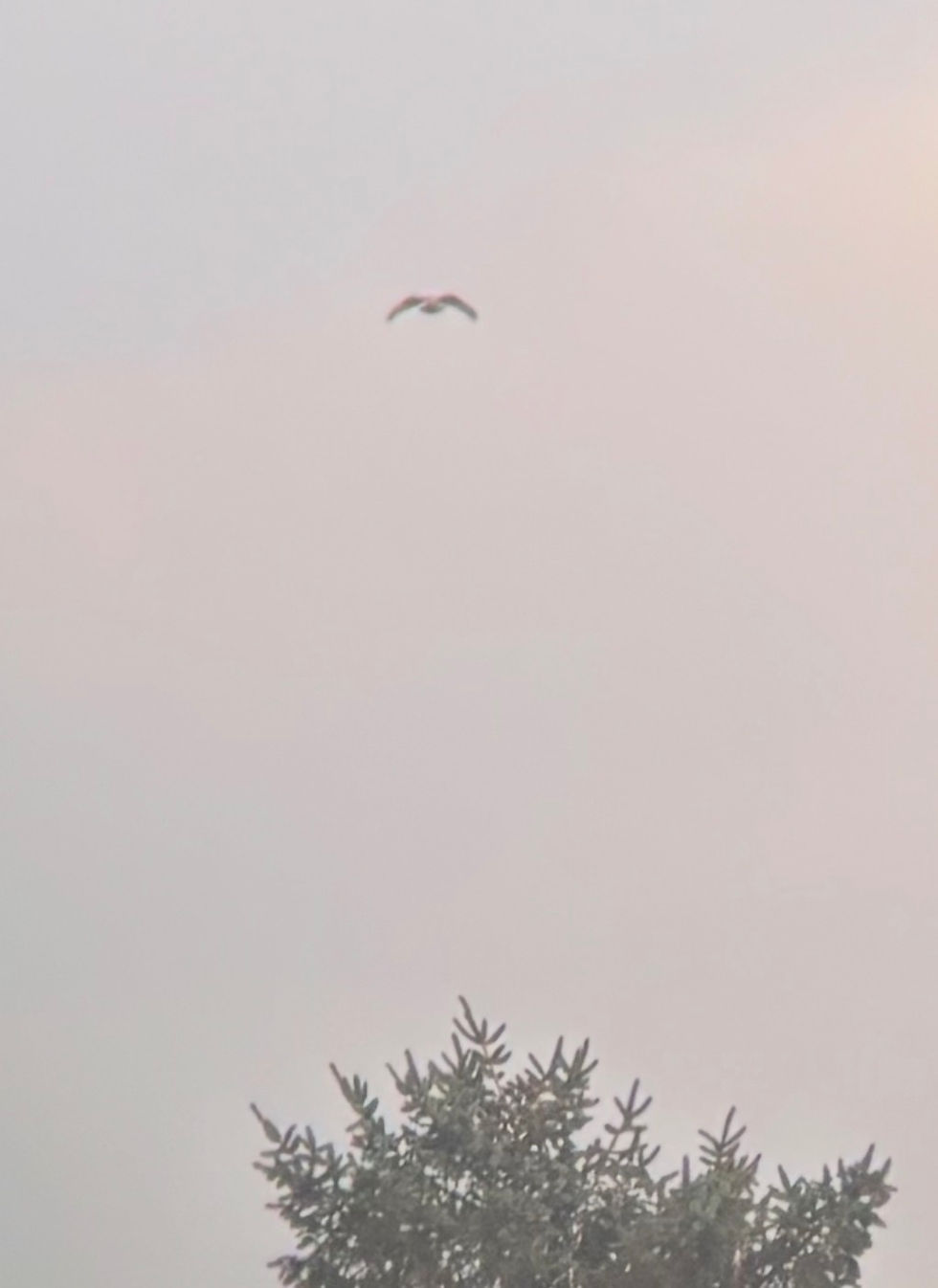
We refound the Rough-leg at the south end of Happisburgh on a rough track to Cart Gap. It flew a little hunting then alighted on a heap of spoil. It spent a good 20 minutes on the spoil heap allowing prolonged scope views. Andy had to leave but Phil and I remained and we were treated to some close views of it hunting around us, hovering and coming very low at times. The sky was turning some gorgeous colours as the light dwindled and the setting with the lighthouse in the background at times was just wonderful. The bird eventually returned to the spoil heap and the light became too poor to continue watching. I returned home a very happy man. I really like Rough-legs as a species and ended up having some wonderful views of a bird that might now be a genuine rarity in east Norfolk.
Hovering, showing characteristic jizz Perched on spoil heap side view
The next morning was a bit of a dilemma. I was very keen to see some more of the Rough-leg in good light but slightly wary that there might be a bit of a crowd for what is now a very difficult bird to see in the UK. Plenty of birders will turn up for anything if it’s on the new services, so I had envisaged several people being there. However, not only did we see no-one looking on the Saturday or Sunday, remarkably there was no-one there on Monday morning when I arrived. Bob Cobbold arrived and before long I saw the bird again and we enjoyed more good views of the bird as it flew around the lighthouse field and then started moving north. We met three other visiting birders who had also seen the bird from a different angle and were similarly delighted. I stayed for another 30 minutes but the bird never reappeared and wasn’t seen again as far as I’m aware.
Description:
At a distance, the bird initially appeared as a strikingly long-winged and rather ‘flappy’ buzzard. It flexed its wings downwards occasionally (sort of like an extreme Osprey if you get my drift) and had a real Rough-leg jizz about it. At closer range it was possible to see a lot more plumage detail. The head was pale with a few darker areas, notably a line through the eye and backward. The plumage on the back was admixed with several paler feathers. The underwing was very white-looking but with very dark and large black carpal patches. There were two large dark belly patches forming a single larger dark area contrasting with the paler upper breast. The uppertail in flight was bright white at the base with a large blackish band distally. The bird frequently hovered and showed characteristically angled wings, especially if seen head on.
All in all, not a bird I was at all expecting but such experiences are often the most exciting – and this one definitely was. As we continue to warm, we may still get the occasional Rough-leg, maybe even a good year, but the pattern is clear. Make the most of the next one you see.


Comments