
Montagu's and Mysteries.
Firstly, thanks to Sean and Chris for taking and sharing the photos, Sean and Andy for early and rapid discussions of the ID, and Sean and Mick for their company and their skills in the field. Montagu’s Harriers used to breed in the Horsey area back in the 1950s but even a single sighting a year now would be very notable. This makes recent events particularly noteworthy.

On Fri May 30, I was making my daily check on the Black-winged Kite in Sea Palling when I bumped into three old-school birders - Julian Hough and his two mates, Tom and Simon, who had stayed at Chris Mills’ the previous day. We enjoyed distant views of the bird but the highlight was a great and often hilarious chat about the Scilly era, the lack of birds these days and the state of modern birding. As they departed I suggested a look from near Stubb Mill for a chance of Red-footed Falcon. Although they didn’t turn up a falcon they did have distant views of a Pallid / Montagu’s Harrier east over the Horsey straight area.
The next morning a ringtail harrier, thought to be a Pallid was seen moving east from Walsey Hills and about three hours later a possible Pallid was reported from the Winterton area. Things seemed to be resolving when the Walsey bird was identified from photographs as an adult female Pallid Harrier. By now, Sean had sent me some pics of the Winterton bird and although they weren’t the best, they showed (in my opinion) a 2cy bird with the trailing edge to the primaries and paler face / eye surround of a Montagu’s. The lack of a clear neck boa, the wing formula, a decent hint of axillaries and heavier breast and flank streaking than a Pallid added further to the picture. Sean had come to a similar conclusion but our views were clearly at odds with it being the adult Pallid from Walsey earlier. Maybe two birds?
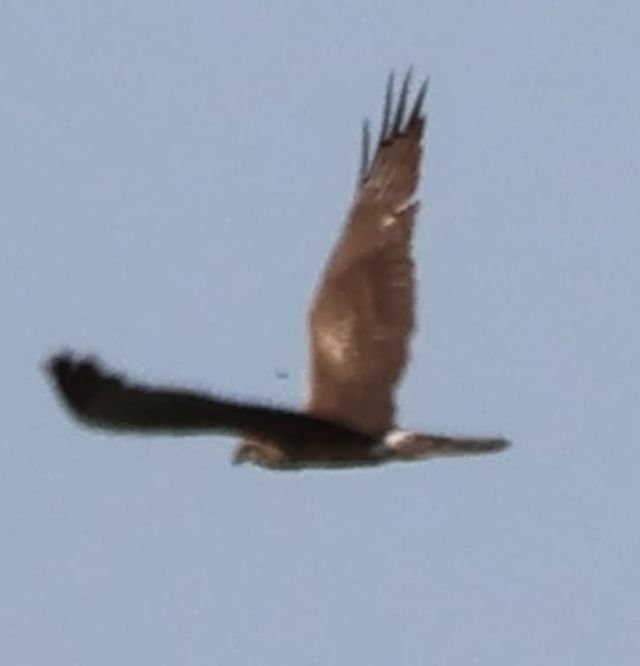
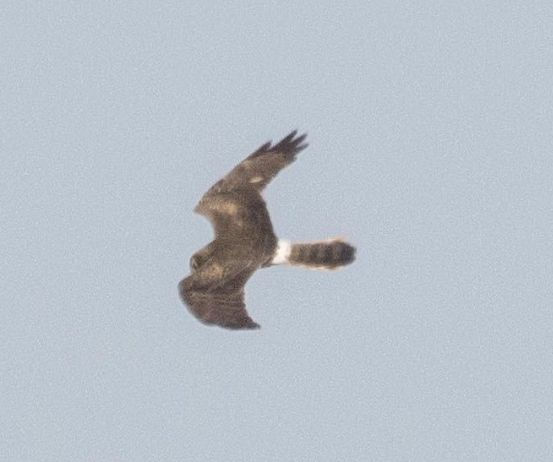
The initial photos from Chris at Winterton show a 2cy bird with peachy underparts, a dark trailing edge to the primaries, a whitish eye surround, a hint of rusty-barred axilllaries, streaking onto flanks and belly, and a clearly three-fingered hand with a short p6.


I put the photos on our local Whatsapp with the comment that I considered the bird to be a Montagu’s Harrier for the reasons noted above. I had a quick chat with Andy Kane about the bird and he was of the same opinion about it being a Montagu’s. Pallid Harriers are now far commoner than Montagu’s in Norfolk, especially in east Norfolk. It’s been several years since we’ve seen a Montagu’s in TG42 so this bird was genuinely exciting to have locally. I put a couple of hours in that afternoon on the Horsey straight trying to locate it while Sean was watching from Winterton North Dunes. I had very distant but inconclusive views in the heat haze of what was probably the bird but had to let it go. The intrigue deepened when I was informed by Chris Mills that the adult Pallid Harrier at Walsey was actually a 2cy female Montagu’s, the same as our bird. There was no sign of the bird all day so on Monday morning I joined Mick Saunt to search for it around the Nelson Head track.
I hadn’t been there more than a few minutes when I had a brief view of it very low and quartering the field, flying between the numerous large bushes. I called Mick over and after a couple of minutes, the bird appeared again at fairly close range and it was indeed the 2cy female Montagu’s. We enjoyed some great views, along with Tim Hodge, as it hunted the area north and south of the track and coasted down the dunes. After a couple of hours I left for home and a late breakfast.
There was now a fair bit of conjecture about the birds seen at Walsey, Winterton on Fri/Sat and Winterton on Mon being different individuals. I was very sceptical about this, not just due to Occam's razor but from having looked at several photos and come to the conclusion that I couldn’t find a solid reason to consider that more than one 2cy female was involved. The photos were not the best, there was a good deal of blur, distortion, shadow and differences from the birds’ postures and lighting conditions and it was tricky to be sure of much, other than the fact that it was clearly a 2cy female with little to point to any other birds being involved. The situation wasn’t helped by people who hadn’t seen the birds coming to conclusions based solely on the poor quality photos available. In one photo, a blurred primary feather appeared to have been cut vertically, parallel to the feather shaft in a wavy line - something I have never seen in a bird before. This was clearly something to do with the processing of the image and subsequent conversations with people who use Lightroom, put it down to AI de-noising or similar. The ridiculously “damaged” feather was not seen on any other photos of the 2cy female. I went down on Monday evening with Andy but surprisingly there was no sign of it at all. I did, though, succeed in getting spectacularly wet.
I had to work on Tues and couldn’t get down there but there was no report of the bird. However, as several locals were unable to visit for various reasons, I didn’t read too much into that. Sean was back on Wednesday and managed to get some good views and photos of the bird. We discussed these on our Whatsapp and things started to get really interesting. As well as photos of the 2cy female against the sky, there were some photos of a 2cy bird that appeared to have some different plumage features. I spent a good while looking at the axillaries and underwing trying to work out what on earth was going on and why the peachy tones of the bird had become much duller. A better look at the upperside of the bird made things much clearer – there were some dull grey-toned feathers in the mantle and the moulted (newer) central tail feathers were of a similar hue. The bird was definitely a 2cy Montagu’s harrier based on several features but this one was a male! It wasn’t particularly advanced but nonetheless it was a 2cy male. Things were made even more mysterious as Sean had only “seen” the 2cy female in the field and not the 2cy male. With the benefit of hindsight it now seems that the 2cy male didn’t linger and was fortunately snapped by Sean during its brief stay. It was reported as present the next morning but I can’t confirm the veracity of the sighting at present. As far as I am aware, the male was not photographed by anyone else either. As two birds were present, and despite the fact that the chance of breeding taking place seemed almost non-existent as the birds were both very young, it was thought better to keep things under wraps as much as possible. Relevant people were informed but before long it seemed everyone with a camera and/or bins knew the situation.
2cy fem Montagu's. Note the barred axillaries, dark trailing edge to underwing primaries, streaked flanks, breast and belly. Ring visible in Pic 1. Pix Sean Offord.
2cy male Montagu's Harrier. Note new grey central tail feathers, grey in mantle, grey tones to head and neck, dark secondaries and short p6 etc. Pix Sean Offord.
There was a report of nest material being gathered but this doubtless referred to vegetation being picked up by the bird as it caught prey from the grass. I witnessed this myself – the bird landed, came up with a chunk of grass and dirt, landed a short distance away, and proceeded to eat whatever it had caught before taking off again completely empty-taloned having discarded the vegetation. I went down that evening to check on them and looked for the birds with Paul Nobbs and Mark Ward but left disappointed, with neither being seen.
I took the bike down on Friday and had excellent views early on before meeting Sean and settling in the dunes to watch the 2cy female hunting over the fields. All was good until not long before 10:00 it rose up and started circling, catching a thermal and spiralling very high before gliding off south. It appeared to be off! It then caught another thermal and started rising even higher before gliding off again south. It did this four or five times, each time gliding further away until it was a huge challenge to discern the bird, even against bright cloud. It was probably over Acle by then.
There were no further sightings although on Sunday I had a brief view of a ringtail harrier in Sea Palling. I called Andy but the bird must have gone through. A Montagu’s Harrier was reported from the Horsey only minutes after my sighting. However, I wouldn’t go any further than ringtail harrier for mine and there have been no further details of the Horsey sighting.
Next spring will be interesting. The birds may return…
Incidentally, the 2cy female Walsey bird from Saturday seems to share a similarity in the right wing with the Winterton 2cy female, indicating that it is very likely the same bird and that one 2cy female was involved in all the sightings.

Comments